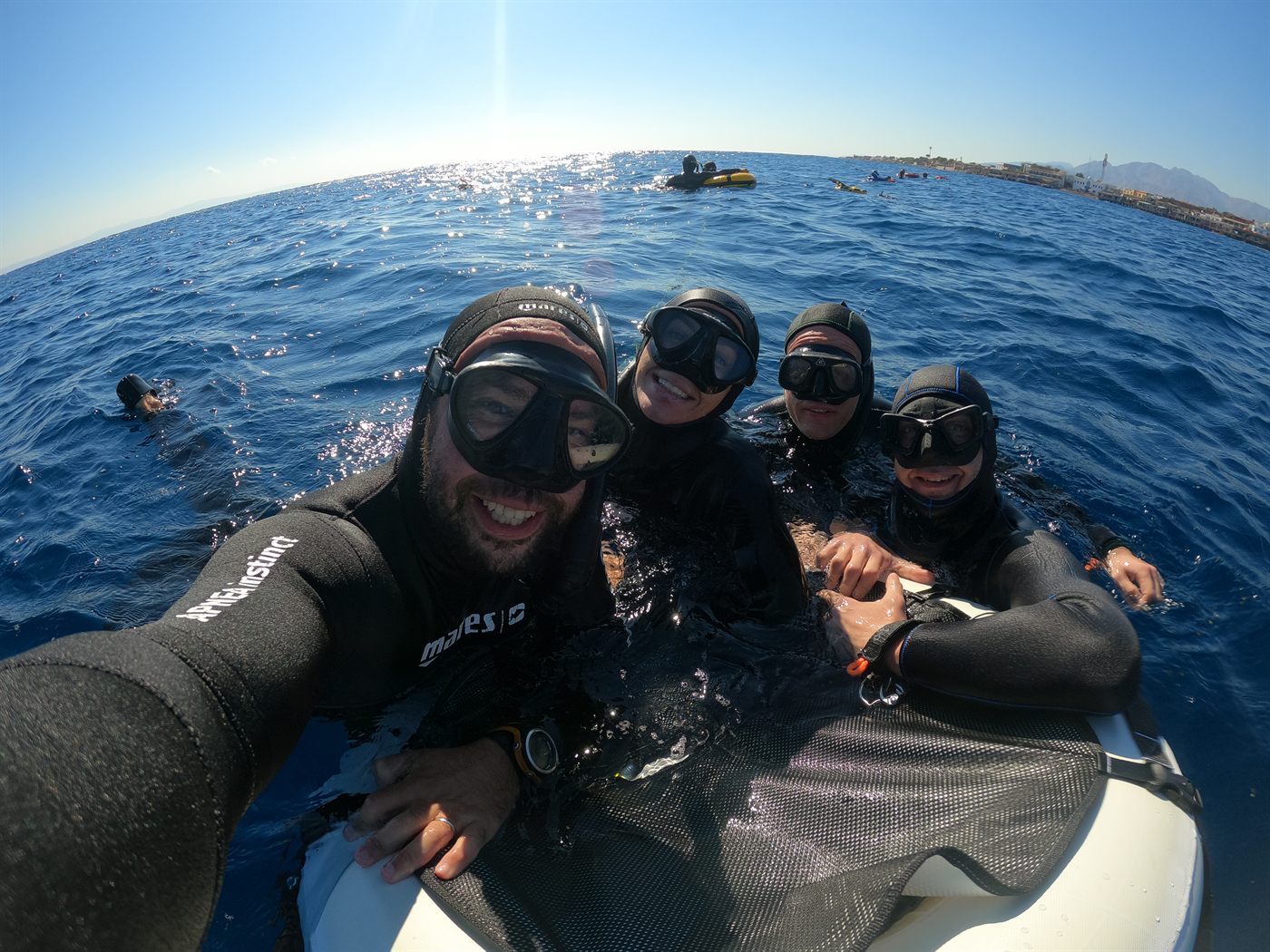
Trauma does not only live in memory. It lives in the body. For someone with Post-Traumatic Stress Disorder, the brain's alarm system, the amygdala, gets stuck in the on position. The body stays flooded with stress hormones, scanning for danger that is no longer there, bracing against a threat that has already passed. It shows up as hypervigilance, anxiety, numbness, and a quiet, exhausting disconnection from one's own body.
Talk therapy is powerful, but for some people, recounting the event from the top down can reopen the wound before it can close. So a remarkable shift is happening in mental health: psychologists and therapists are beginning to recommend freediving as a complementary, body-based path to recovery. At Freediving Brain we welcome students who arrive with exactly that suggestion in hand.
Plunging into the deep on a single breath might sound like the last thing a nervous system seeking safety would want. But the water, handled with care, becomes one of the most structured, contained, and forgiving environments a body can relearn safety in.
Our foundation
At Freediving Brain, courses are built on a foundation of neurological safety. We understand the water is a therapeutic space for many who walk through our doors, and we teach accordingly, slowly, gently, and never past the point of comfort.
Why therapists are turning to the water
The most cutting-edge ideas in trauma recovery share a common theme: you often cannot think your way out of a trauma response, because the response does not live in the thinking brain. It lives in the autonomic nervous system, below conscious control. To change it, you have to work with the body and the environment directly. This is the bottom-up approach, and water is one of the most effective tools we have for it.
Four ways the water helps the trauma brain
None of this is mysticism. There are four concrete mechanisms at work, each one meeting a specific feature of the trauma response.
01
Somatic reclamation, coming out of freeze
When fighting or fleeing is impossible, the nervous system defaults to freeze, and survivors often feel numb or detached, because living in the body feels unsafe. Freediving asks for gentle, positive attention to the body, the breath, the shoulders, the slow coordination of a dive, inviting a person back into themselves in the present moment.
02
Volitional stress, panic on your own terms
The core of trauma is a loss of control. In freediving, we step into a manageable physical stress, the urge to breathe, but entirely by choice and entirely on our terms. Meeting that urge with calm rather than panic rebuilds a sense of agency over the body's survival instincts.
03
The hydro-sensory cocoon, nothing can sneak up
The hypervigilant brain is exhausted from filtering threat. Underwater, sound softens, light becomes a calm spectrum of blue, and weightlessness lifts pressure from the body. It is an environment where, for once, nothing can sneak up on you, and the guard is finally allowed to drop.
04
Co-regulation, safety in another's presence
Trauma fractures trust. In freediving, the buddy system is law: you cannot dive well unless you trust the person on the line. Breathing beside a calm instructor, held by their steady attention, the nervous system co-regulates and slowly relearns that another human can mean safety.
Moving out of freeze
The freeze state is a kind of protective shutdown. The body goes quiet and far away because being present in it has felt dangerous. The work of recovery is not to force a way back in, but to make the body a safe enough place to return to. Water helps with something most environments cannot offer: gentle, even pressure on every surface of the skin at once.
This hydrostatic pressure acts like a soft, full-body container. It gives the nervous system a clear, constant sense of where the body ends and the world begins, which can feel profoundly grounding for someone who has spent years feeling unboundaried or unsafe in their own skin. Tuning into the small sensations a dive requires, the lungs expanding, the shoulders softening, becomes a way of inhabiting the body again, one safe signal at a time.
Panic on your own terms
On land, panic ambushes. It arrives without warning and leaves a person feeling helpless, which is the very heart of the trauma loop. Freediving offers something radically different: a stress you choose, that you can stop at any moment, met with calm instead of alarm.
When the brain registers rising carbon dioxide during a breath-hold, it sends a warning that can feel like the early edge of a panic attack. Here is the breakthrough. With an empathetic instructor beside you, you learn to meet that signal with relaxation, and to discover, in your own body, that a feeling of distress is not the same as being in danger. Each calm breath-hold rewrites the loop.
The blue cocoon
For a trauma brain, the ordinary world is loud. Every sudden noise, every movement at the edge of vision, is a small spike of cortisol, a threat to be checked. The cost of that constant filtering is enormous, and it never quite switches off.
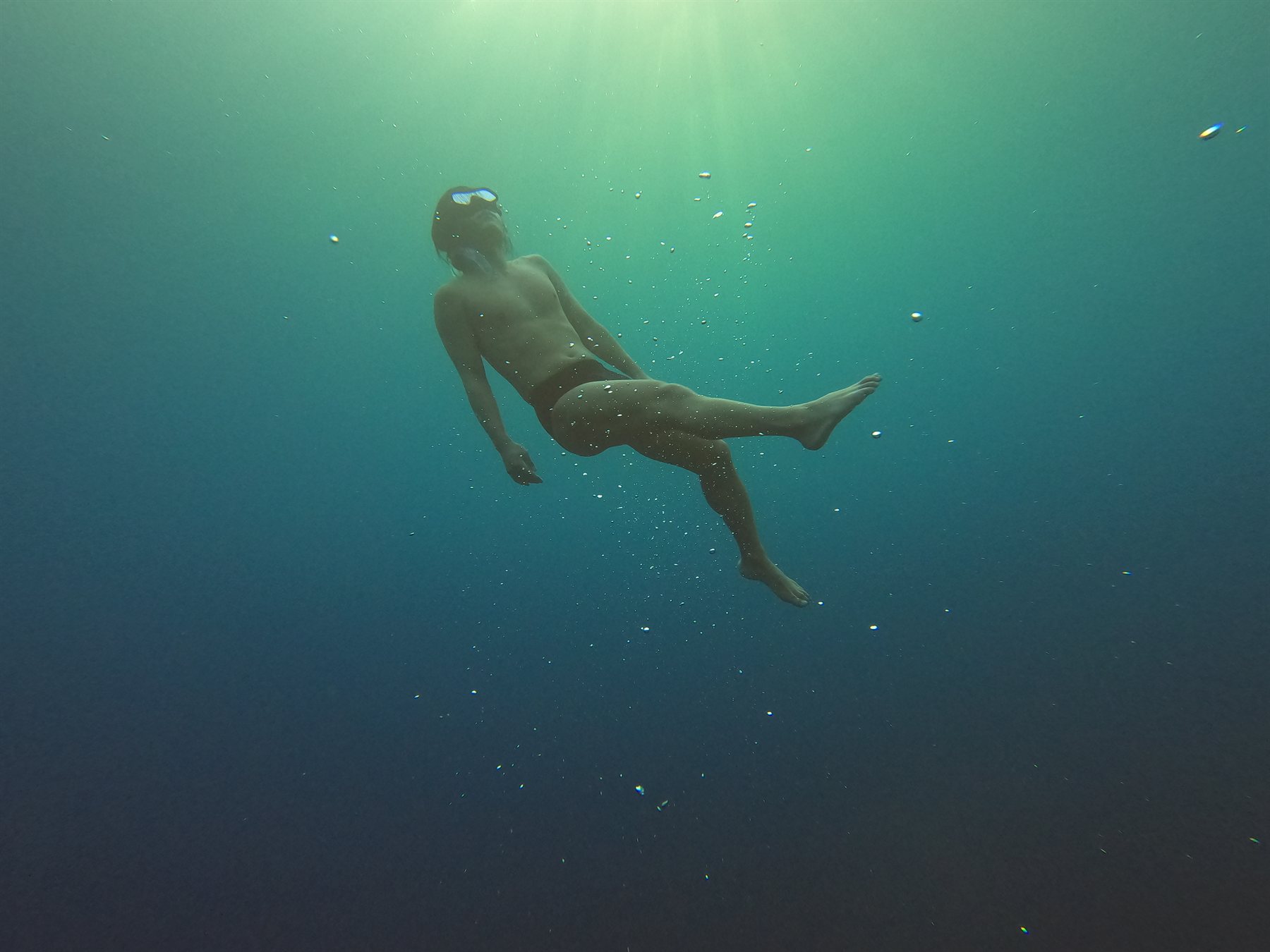
Underwater the input falls away, muffled sound, soft blue light, weightlessness. The guard is finally allowed to rest
The underwater world works like a natural sensory-deprivation tank, but a beautiful one. Sound is muffled, sight softens into depth, and gravity releases its grip on tired joints and muscles. With so little external data to process, the hypervigilant brain can do something it rarely manages on land: it can stand down. There is, quite simply, nothing here that can sneak up on you.
Healing happens in relationship
Trauma is isolating, and it often breaks our ability to trust other people. This is where freediving does some of its quietest, deepest work. You cannot dive safely without trusting the person holding the line for you, so trust is not a topic to discuss; it is a thing you practise, breath by breath.
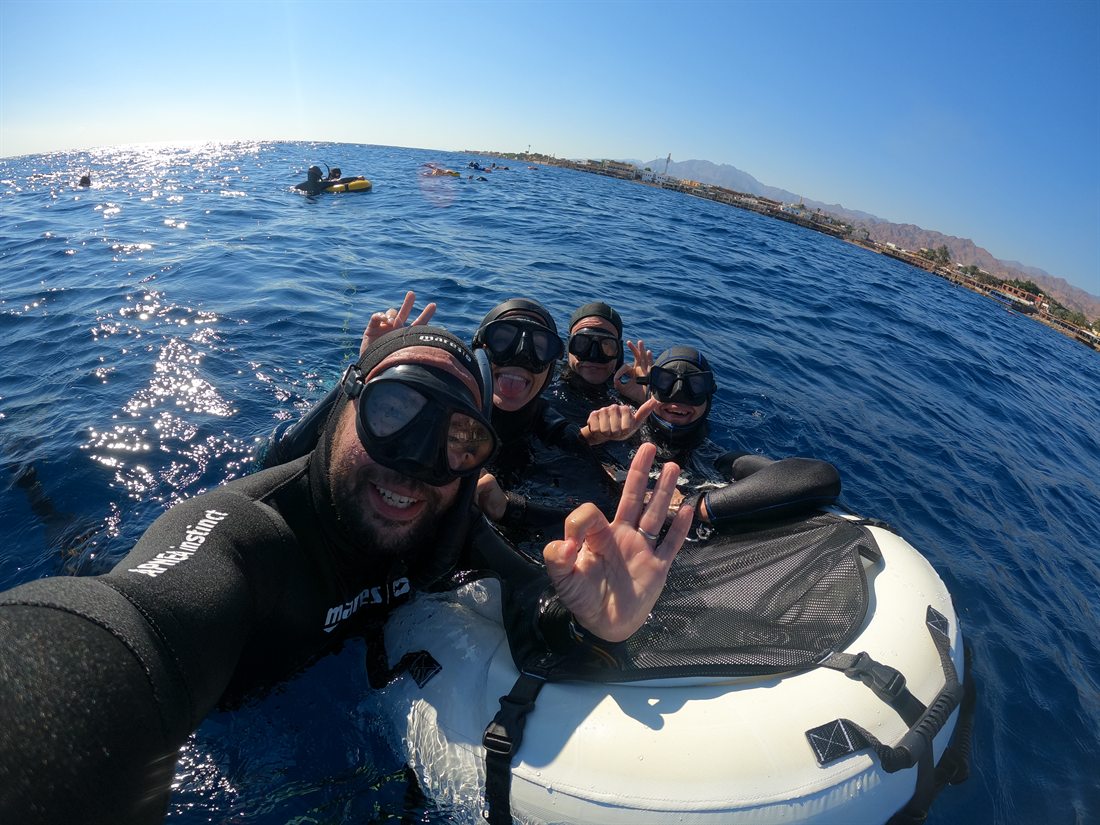
The buddy system makes safety a shared act, co-regulation you can feel
Looking into a calm instructor's eyes before a dive, breathing together on the surface, knowing you are being watched over with genuine care, the student's nervous system begins to borrow the steadiness of the people around them. Scientists call this co-regulation. In plain terms, it is the slow, repaired discovery that you can feel safe in the presence of another human being. For many trauma survivors, that is the most important dive of all.
A trauma-informed approach
Teaching a student sent by a psychologist means setting the sport mindset completely aside. Depth, time, and distance are not the point, and chasing them can be actively harmful, because pushing someone into severe air hunger can trigger a flashback or a panic state. The entire goal of a session is comfort, safety, and a quiet mind.
What success looks like
If a student spends an entire session simply floating at the buoy, breathing slowly and feeling safe in the water, that is not a session that fell short. That is a massive, life-altering victory. We measure progress in safety and calm, never in metres.
Bottom-up healing
Talk therapy works from the top down, changing the mind to calm the body. Freediving works from the bottom up, calming the body through the dive reflex and the embrace of the water until the mind follows. For people who have spent years trying to think their way out of trauma, the water offers a wordless alternative: a place to let go, take a breath, and let the ocean carry some of the weight.
If your therapist suggested the water, you are in good company, and you are welcome here. We will not rush you, and we will not measure you. We will simply help you feel safe, one breath at a time, and let the deep do the rest.
Further reading
- van der Kolk, B. The Body Keeps the Score (2014), how trauma is held in the body and the case for bottom-up, somatic healing.
- Levine, P. Waking the Tiger (1997), Somatic Experiencing and releasing the freeze response.
- Porges, S. W. The Polyvagal Theory (2011), neuroception, the freeze state, and co-regulation between nervous systems.
- Diving-physiology reviews of the human Mammalian Dive Reflex and breath-hold bradycardia.
General references on the underlying neuroscience. Freediving is presented here as a complement to professional trauma care, not a clinically proven treatment.